AI in test: solving exam questions
Can AI get students through exams?
From the end of 2022, ChatGPT from the US company Open AI was also available on the internet in Germany. Naturally, the hype about artificial intelligence (engl.: Artificial Intelligence) that this triggered did not pass me by either. Because at that time I was still working as a lecturer, I was initially mainly interested in the question of whether AI has the potential to get students through an exam or to produce a coursework assignment.
To find out, I asked ChatGPT to solve some of my exam questions on the subject of wastewater from the master's programme Urbane Infrastrukturplanung - Verkehr und Wasser, Modul Entsorgung at the Berlin University of Applied Sciences. However, I excluded questions that required a calculation.
Below is the question-and-answer session with ChatGPT, conducted on 2 March 2023.
Question 1 (3 points)
The residence time of wastewater in the aeration stage of municipal sewage treatment plants in Germany is on average about 8 hours. This typically allows the regulatory requirements for the elimination of organic wastewater constituents measured as COD to be met and undershot. In sewage works treating wastewater with high proportions of poorly degradable constituents (e.g. in the chemical industry), however, significantly longer residence times (24 … 48 h) must be used, and often two or more biological treatment stages must be arranged in series to comply with the regulatory COD effluent values.
Why?
In your answer, take into account the theory of COD degradation in aeration plants!
Screenshot of ChatGPT's answer to Question 1:
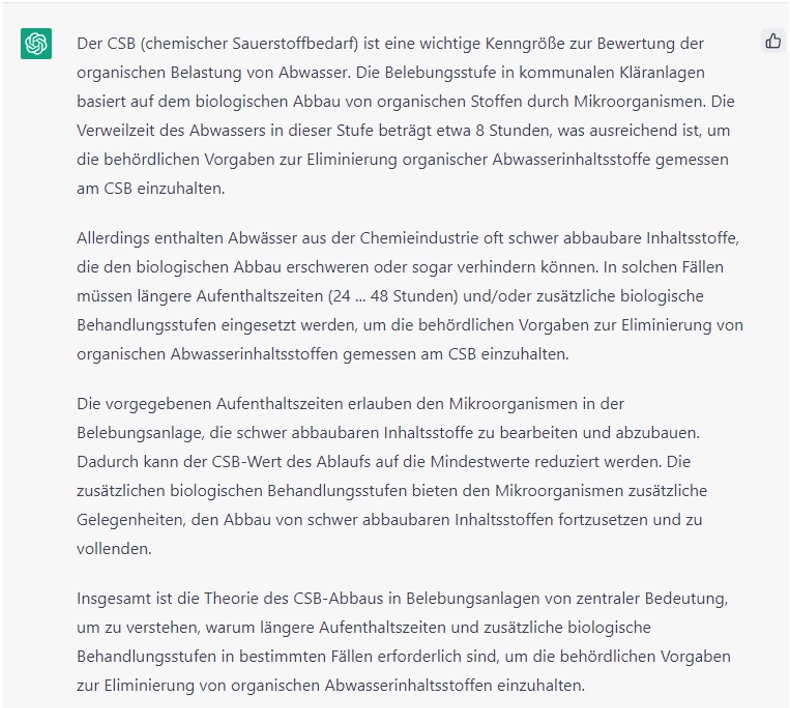
ChatGPT correctly explained that poorly degradable constituents require longer biological degradation processes. On one hand because the microorganisms need more time to metabolise these substances, and on the other hand because the breakdown of refractory compounds requires bacteriological "specialists" that only become active after a longer residence time. The latter was not described by ChatGPT. However, the answer took into account the kinetics of COD degradation and the need for multi-stage treatment systems, so only one point is deducted.
Question 2 (2 points)
Why has post-denitrification been abandoned again even on an international scale?
Screenshot of ChatGPT's answer to Question 2:
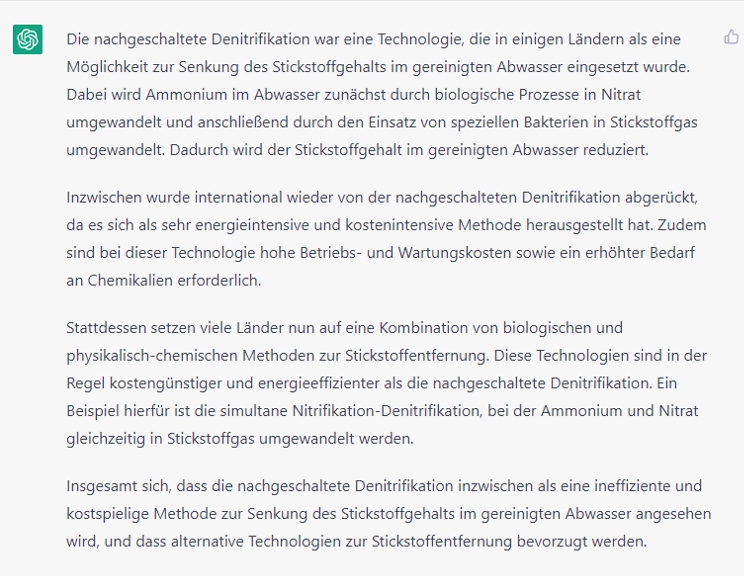
ChatGPT named the main reasons: higher energy demand, the need for an external carbon source, and the preference for pre-denitrification as a more efficient alternative.
Question 3 (4 points)
What is the purpose of internal recirculation in pre-denitrification?
Demonstrate using the formula for the maximum achievable efficiency of pre-denitrification (see DWA-A 131, p. 49, formula 53) that increasing the recirculation ratio (RF) beyond a factor of 3 yields diminishing returns. Apart from the calculated result, in practice an increasing deterioration of denitrification is observed for RF values above 3. What is the reason for this?
Screenshot of ChatGPT's answer to Question 3:
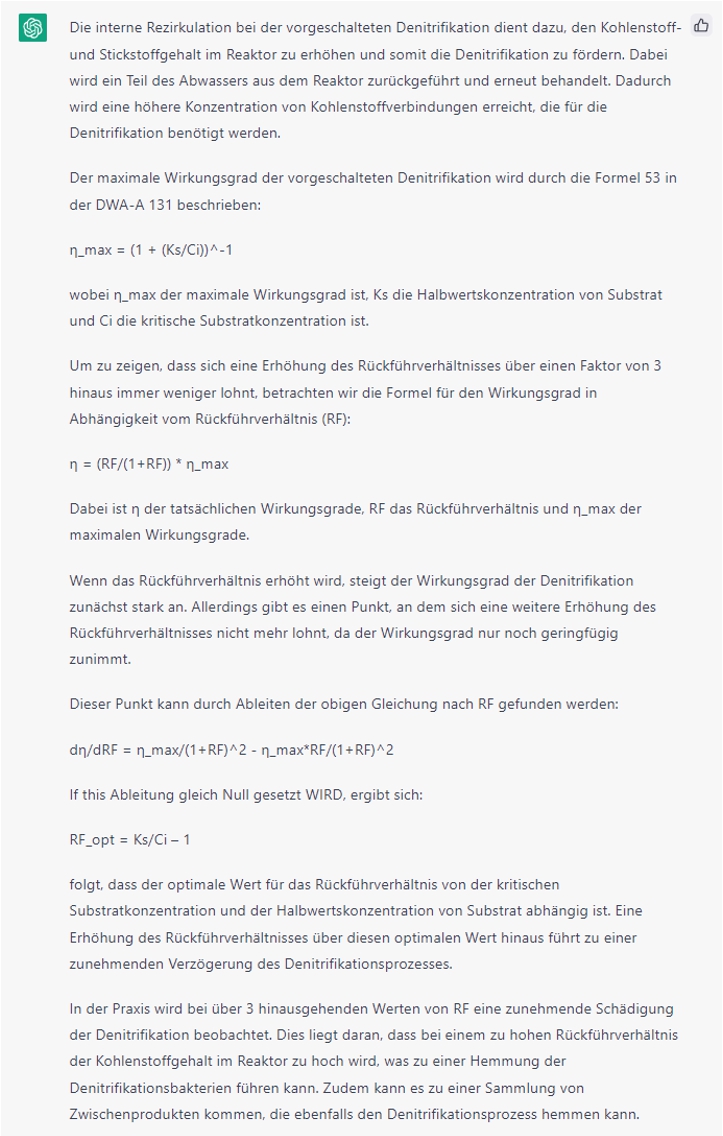
ChatGPT correctly explained the function of the internal recirculation and showed mathematically why RF values above 3 provide little additional benefit. The justification for the collapse of denitrification at excessively high return ratios was incorrect; not a carbon shortage but the presence of dissolved oxygen is the cause.
(1 point deducted because it is not carbon but an excessive content of dissolved oxygen that disrupts denitrification)
Question 4 (4 points)
When a combined sewer overflow is activated due to rain, a portion of wastewater requiring treatment is always carried into the receiving water. Why should such discharges be classified as significantly more critical than the treated effluent from sewage treatment plants?
Screenshot of ChatGPT's answer to Question 4:
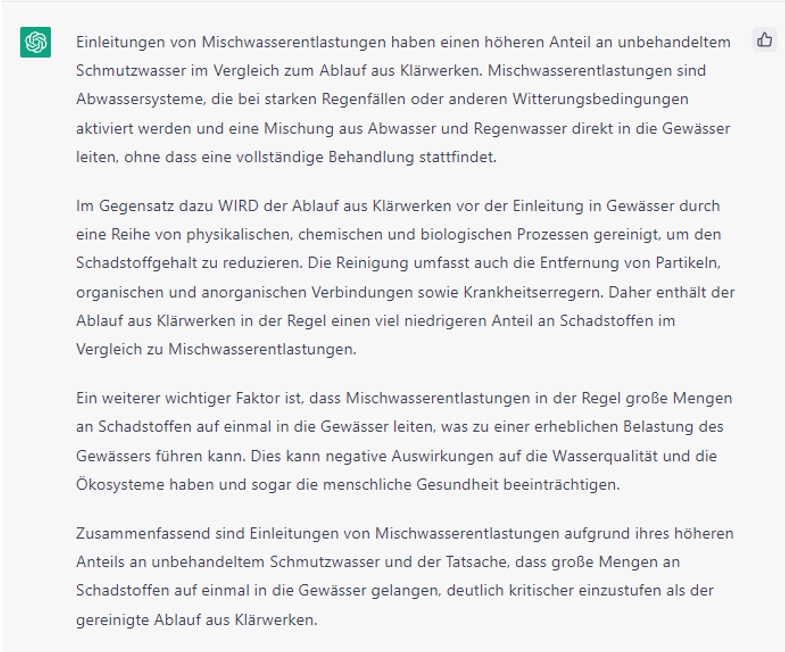
ChatGPT listed all the essential points: higher pollutant concentrations, shock loading, lack of treatment, oxygen depletion and ecological impacts.
Question 5 (5 points)
Describe the interaction of the throttle and the stormwater overflow basin in the inlet to a sewage treatment plant (overflow basin arranged in the bypass)!
What are the flow paths of the combined wastewater during storm conditions, when
- a) that the storm overflow basin still has sufficient storage volume, or
- b) that the storage volume in the storm overflow basin is exhausted.
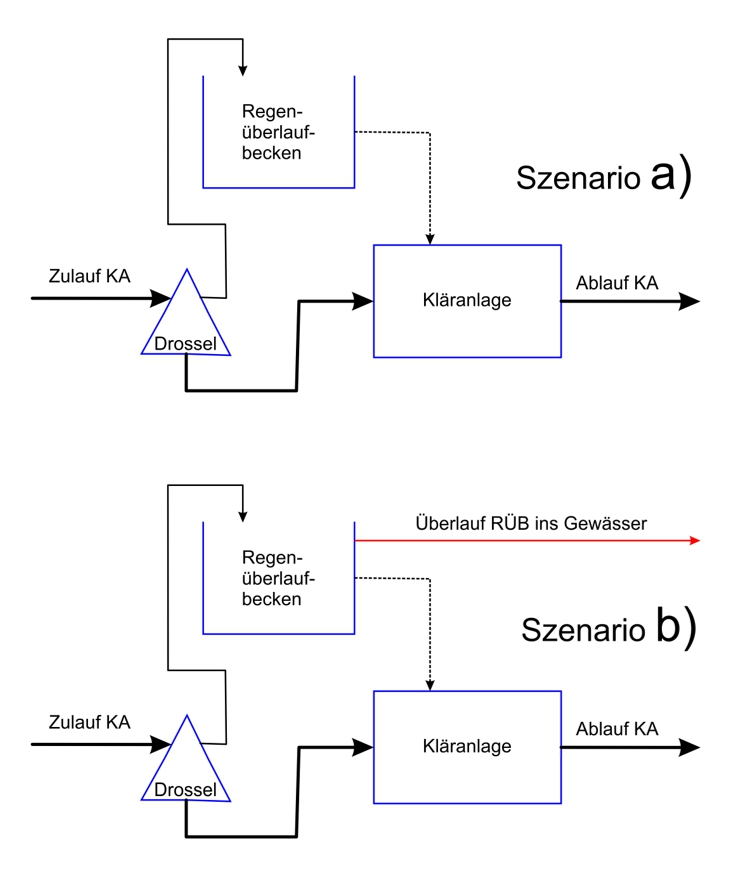
Draw a sketch of the respective flow paths and give a brief verbal explanation of these scenarios!
Screenshot of ChatGPT's answer to question 5:
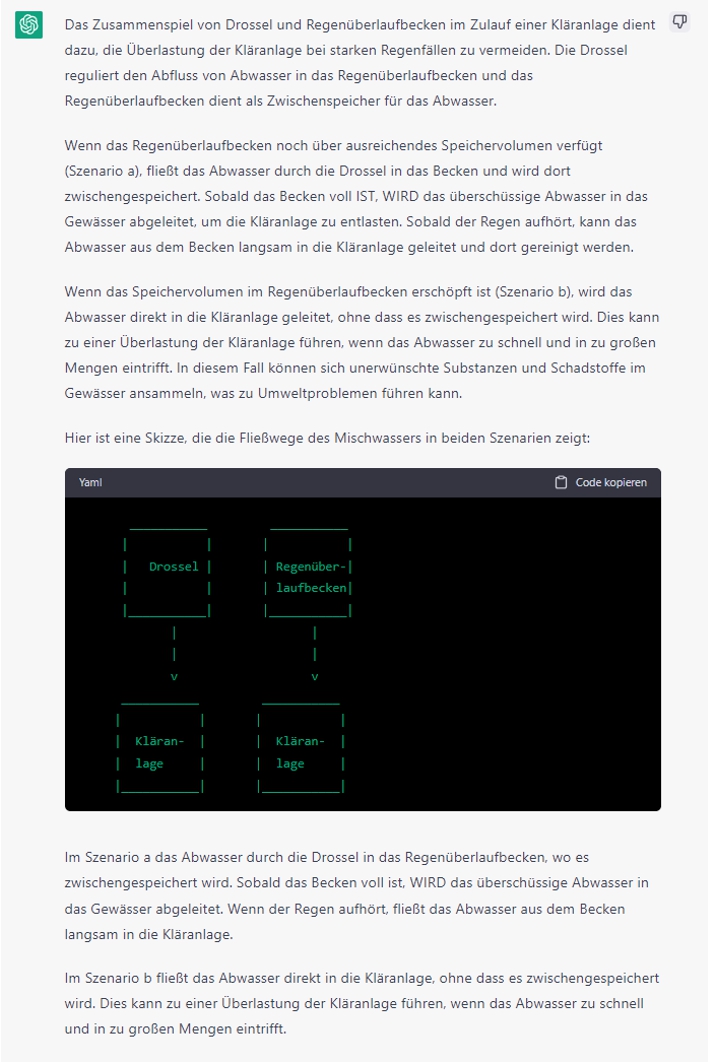
ChatGPT provided an inadequate answer that completely misconstrues the purpose of the interaction between the throttle and the SOB.
Comment: ChatGPT does not recognise the interaction of the throttle and the storm overflow basin in the inflow to the sewage treatment plant. The function of the throttle is completely ignored, so that in scenario b) it even hallucinates an exceedance of the sewage treatment plant's hydraulic capacity.
In fact, however, the throttle ensures that the wastewater flow rate is limited to the value that the sewage treatment plant can accept hydraulically at most. Everything exceeding that is directed into the storm overflow basin (SOB). If the inflow to the sewage treatment plant falls back to the dry-weather flow rate, the wastewater from the SOB is — subject to available capacity — sent to the sewage treatment plant and treated there. But if the SOB is full while the throttle still diverts wastewater to the SOB, discharge to the receiving water must occur.
Conclusion and comparison
ChatGPT (March 2023)
67% of the attainable score
Manus AI (October 2025)
89% of the attainable score
Summary
Most questions were answered by ChatGPT more or less correctly. However, the AI faltered on the question about the interaction of the throttle and the storm overflow tank in the inflow to a sewage treatment plant.
I asked the same questions to 13 October 2025 also Manus AI. The result shows a clear improvement in AI performance within two and a half years.
Comment: Almost everything correct, exception: it is not carbon but an excessive content of dissolved oxygen that disrupts denitrification when the return ratio exceeds the optimal value!